
Everyday Absurdities: Conceptual Frameworks in the Immediate Space
- Batool Al Tameemi

- Sep 9, 2024
- 3 min read

The spaces we inhabit daily—our rooms, bathrooms, and living areas—are constructed around habits and familiarity. But what happens when these spaces are disrupted? When the objects we know so well are presented in new, absurd, and nonsensical contexts, a shift occurs, both in perception and meaning. Everyday Absurdities is a study in conceptual frameworks within the immediate space, an exploration of how objects can transcend their ordinary functions through disruption, becoming installations that challenge our routine interactions and ways of thinking.



The Space Between Productivity and Absurdity: Drying Racks as Art
A laundry rack, paper notes, and the comfort of a TV show transform the monotony of chores into an installation where the line between productivity and purposelessness blurs. Here, the drying rack becomes a liminal object—a bridge between utilitarian function and conceptual art. It's the space where action, or the suggestion of action, and absurdity coexist.
This is the framework of the liminal moment. It embodies the in-between spaces that define so much of our daily lives but are rarely acknowledged as meaningful. Hanging socks and notes on a rack, watching a TV show mid-activity—these gestures break from the task at hand. By turning this moment of waiting, this non-time, into an artwork, the mundane is elevated, asking the viewer to question why we overlook the moments of pause in our own routines.


Absurd Wisdom: The Inversion of Advice
In 50 Absurd Pieces of Advice You’ll Never Need, a framework of inverted guidance comes into play. These statements—absurd, nonsensical, and entirely impractical—are printed on recycled documents, creating a dual-layered interaction between content and material. This piece confronts the often overwhelming bombardment of advice, rules, and expectations that structure our lives. Advice like “Don’t vacuum your hair” or “Never argue with gravity” sounds ridiculous, yet it mirrors the countless pieces of irrelevant information we passively receive daily.
By subverting the nature of advice, this installation encourages viewers to reflect on how much of our world is governed by guidelines that often feel arbitrary. The humor embedded in this work challenges the rigidity of societal norms, offering a conceptual framework rooted in questioning and the disruption of expected narratives.



Disrupting the Familiar: Objects as Absurdities
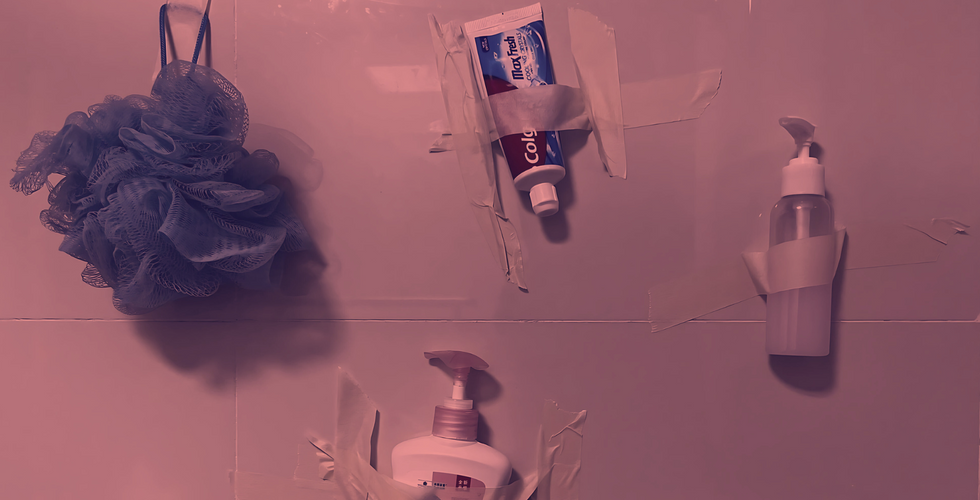
In the installation featuring hygiene products taped to the bathroom walls, the idea is to strip objects of their original, practical function, forcing them into an absurd context. The toothbrush, toothpaste, soap—objects tied to routine, efficiency, and care—are suddenly reimagined as visual noise, dislocated from their role in the act of personal hygiene. This shift is disorienting, but it compels the viewer to reconsider the role objects play in their lives and the relationships they have with these items.
In this conceptual framework, disruption is the tool that breaks apart the expected narrative of everyday life. Through this disruption, familiar objects become art, engaging the viewer with questions of absurdity, placement, and function.
Disruptive Installation: Space as a Site of Inquiry
All the pieces within Everyday Absurdities follow a framework of disruptive installation. They inhabit intimate, personal spaces, like the bathroom or living room, and transform them into sites of inquiry. In these spaces, objects no longer adhere to their roles as passive tools. Instead, they become provocations. The installations disrupt the flow of space, evoking confusion, laughter, and reflection. By intervening in spaces of comfort and familiarity, the installations bring the viewer to question not just the objects, but the systems—of order, efficiency, and meaning—that structure their lives.
This framework of disruption is not simply to provoke but to open a dialogue between the viewer and their environment. It’s a reminder that the everyday can be deeply unsettling when stripped of its predictable narrative.
The Absurd as Reflection
What does absurdity tell us about ourselves? In Everyday Absurdities, it acts as a mirror—reflecting the rigidity of our habits, the mundanity of our routines, and the assumptions we rarely challenge. By creating moments of absurdity, I aim to disrupt this automatic engagement with the world around us, to awaken a sense of play and inquiry.
Final Thoughts: The Absurd as a Conceptual Tool
Absurdity is often dismissed as nonsensical, but when used intentionally, it opens doors to deeper reflection and meaning. Through this blog, I ask the viewer not only to laugh but to reflect on the frameworks that structure their lives. How much of what we do is based on habit, efficiency, or expectation? What happens when we disrupt that? The answer, I believe, is something both absurd and profoundly revealing.
Stay curious,
Batool


Comments